Product demo
Rolling out Claude Code safely with BridgeKit
BridgeKit is our toolkit for software teams adopting agentic coding: a readiness scan, guardrails that block risky actions, checks in CI and an adoption dashboard. This demo follows a fictional company, Fellgate Logistics, through a rollout. Every screen and report on this page was produced by BridgeKit itself, run on a demo repository with sample data.
- Company
- Fellgate Logistics (fictional), a customer portal for pallet deliveries
- The brief
- Let the developers use Claude Code without risking CI, database migrations or secrets
- What we set up
- A readiness scan, guardrails, checks on every pull request and an adoption dashboard
- Readiness
- 64 to 96 out of 100 on the demo repository
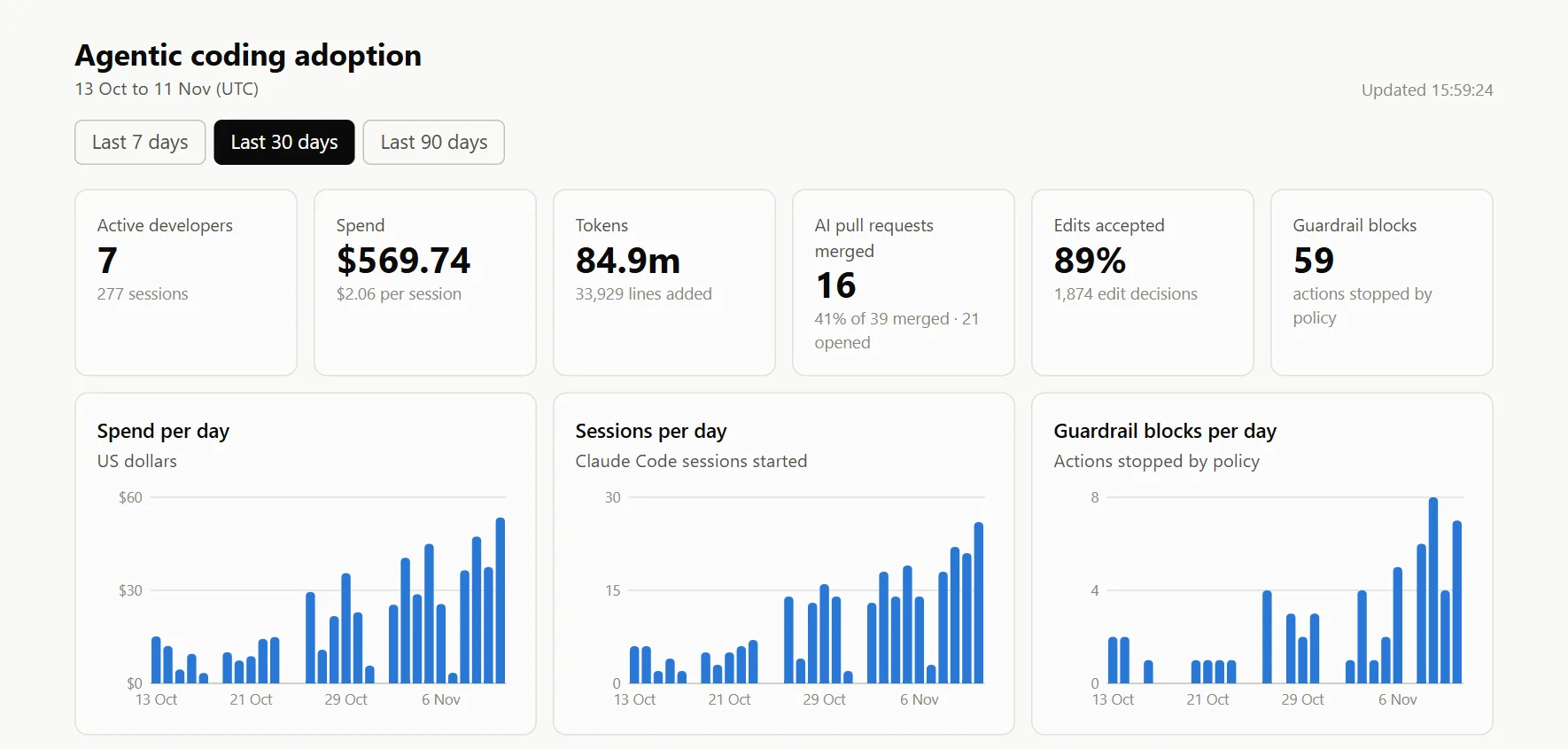
The adoption dashboard, a month into the demo rollout. Fellgate Logistics is a made-up company. The screens, reports and figures on this page come from BridgeKit running on a demo repository with sample data.
The brief
Fellgate's developers wanted to use Claude Code on their customer portal. The team lead's questions were the ones most teams ask. What stops an AI agent editing the CI pipeline or a database migration, pushing straight to main, or pasting a key into the code? What stops it switching its own rules off? And once it's in use, how do we know it's working?
BridgeKit answers each of those with something you can check, not a promise.
How a rollout works
-
Scan
A read-only check of the repository gives a readiness score and a list of what to fix first.
-
Fix the gaps
The team works through the list: tests in CI, instructions for agents, secrets out of the code.
-
Install guardrails
One command sets up the hooks, the CI checks and the agent instructions. A second confirms they work.
-
Measure
The dashboard shows who's using it, what it costs, and what the guardrails stopped.
What BridgeKit does
Each step below shows BridgeKit's real output on the demo repository.
Start with a readiness score
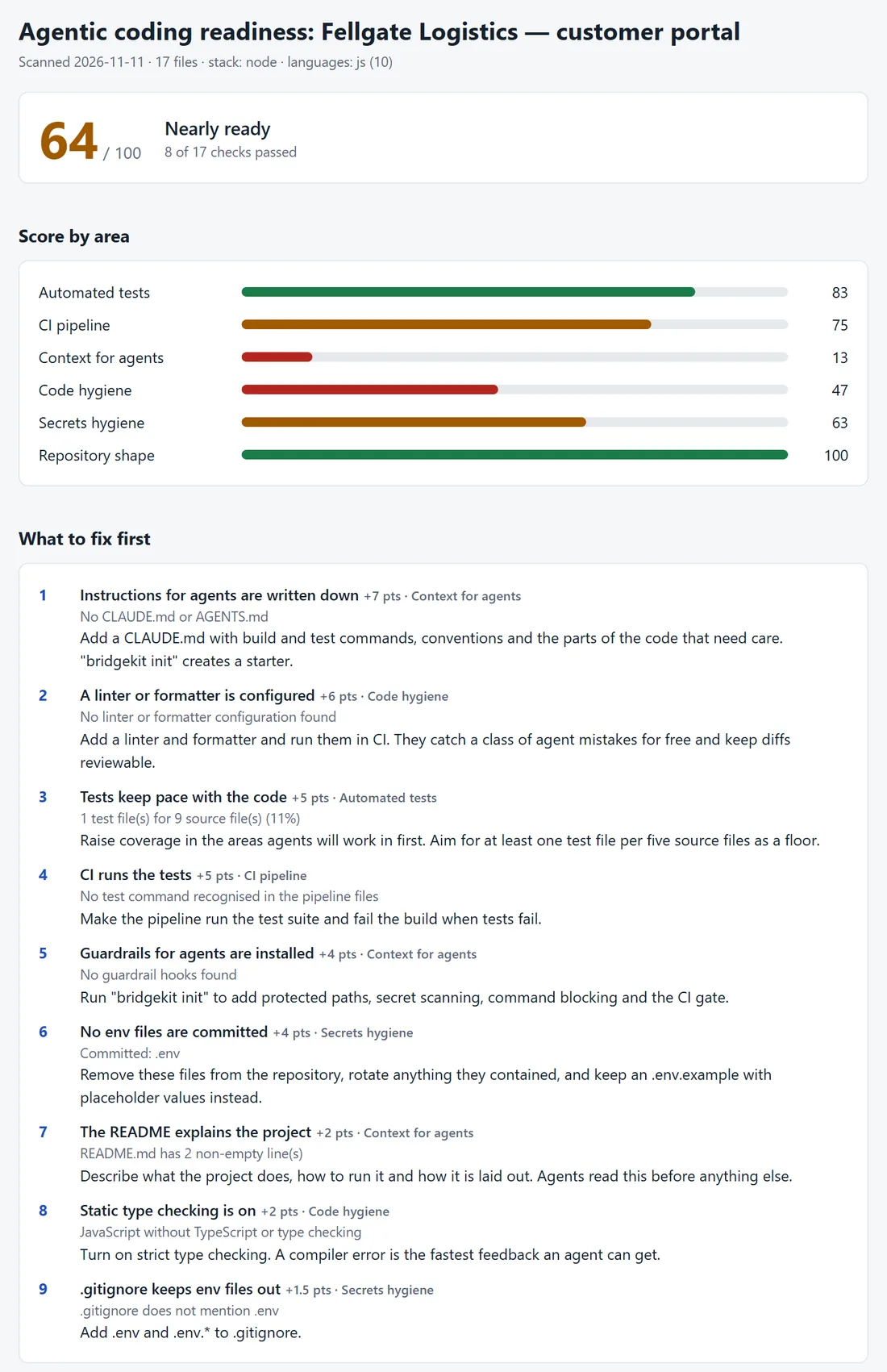
Before anything changes, BridgeKit scans the repository and scores it out of 100 across tests, CI, context for agents, code hygiene, secrets and repository shape. The report lists what to fix first and how many points each fix is worth. It's read-only, a single file that's safe to email, and credential findings name files, never values.
Fellgate's portal scored 64: tests that CI never ran, no instructions for agents, no linter, and an env file committed to git.
Fix the gaps, then scan again
Working down the list took the demo repository from 64 to 96: the tests now run in CI, the env file is out of git, there's a linter, and agents have written instructions and guardrails.
Before64/ 100 · Nearly ready
After96/ 100 · Ready
| Area | Before | After |
|---|---|---|
| Automated tests | ||
| CI pipeline | ||
| Context for agents | ||
| Code hygiene | ||
| Secrets hygiene | ||
| Repository shape |
Guardrails in one command
bridgekit init detects the stack and writes everything: one config file the team edits, the guardrail hook, Claude Code settings, a block of agent instructions in CLAUDE.md, a reviewer agent and skills, and the GitHub workflows. bridgekit doctor then checks the install, including a live test that the hook really blocks.
$ bridgekit init fellgate-portal
Detected: node project "fellgate-portal"
  created   bridgekit.config.json
  created   .claude/bridgekit/hook.mjs
  created   .claude/settings.json
  created   CLAUDE.md
  created   .claude/skills/bridgekit-write-tests/SKILL.md
  created   .claude/skills/bridgekit-safe-refactor/SKILL.md
  created   .claude/agents/bridgekit-reviewer.md
  created   .github/workflows/bridgekit-pr-review.yml
  created   .github/workflows/bridgekit-test-gen.yml
  created   .github/workflows/bridgekit-guardrail-gate.yml
  updated   .gitignore

$ bridgekit doctor fellgate-portal
  ok    Config: bridgekit.config.json is valid
  ok    Hook registration: PreToolUse, PostToolUse and Stop hooks are registered
  ok    Hook smoke test: a force-push was blocked as expected
  ok    Workflow guardrailGate: .github/workflows/bridgekit-guardrail-gate.yml
  warn  Repository secret: the Claude workflows need an ANTHROPIC_API_KEY secret on GitHub (not checked from here)
  …
0 failure(s), 1 warning(s).
Risky actions stopped before they happen
The hook runs before every file edit and shell command the agent makes. It blocks edits to protected paths (CI, migrations, infrastructure, env files), any change to the guardrails themselves, credentials written into code, force-pushes and pushes to main, package publishing, and piping downloads into a shell. Each block tells the agent why, so it can ask a person instead. And before the agent says it's done, the tests run; if they fail, it's sent back to fix them.
A policy test runs sample actions through the rules, so the team can see exactly what is allowed:
$ bridgekit policy test policy-demo.json --dir fellgate-portal
  ALLOW Edit ordinary source file
  ALLOW Run the tests
  ALLOW Push a feature branch
  DENY  Edit a CI workflow
        [protected-path] .github/workflows/ci.yml is a protected path (.github/**). Do not modify it; describe the change you need and ask a person to make it.
  DENY  Edit a database migration
        [protected-path] db/migrations/002_drop_users.sql is a protected path (**/migrations/**). Do not modify it; describe the change you need and ask a person to make it.
  DENY  Switch the guardrails off
        [self-protection] bridgekit.config.json is part of the guardrail setup and can only be changed by a person. Ask the user to make this change.
  DENY  Write a private key into source
        [secret] This edit appears to contain a secret (Private key block). Read it from an environment variable or secret store instead.
  DENY  Force-push
        [blocked-command] Force-pushing rewrites shared history. This command is blocked by team policy; ask the user to run it if it is really needed.
  DENY  Push straight to main
        [blocked-command] Pushing directly to main is not allowed. Push a feature branch and open a pull request.
  DENY  Publish a package
        [blocked-command] Publishing packages is a human decision. This command is blocked by team policy; ask the user to run it if it is really needed.
  DENY  Pipe a download into a shell
        [blocked-command] Piping a download straight into a shell runs unreviewed code. This command is blocked by team policy; ask the user to run it if it is really needed.

11 case(s), 0 unexpected result(s).
A second check that a pull request can't switch off
A hook can't see everything a shell command writes, so every pull request is checked again in CI. The gate finds the AI-authored commits and re-checks them against the policy from the main branch, so a pull request can't loosen its own rules. Here, an AI-written commit added a database migration, and the check failed the pull request for a person to review.
Using guardrails from main.
BridgeKit gate: checked 1 AI-authored commit(s), skipped 0 human commit(s).
  [protected-path] e644f477 db/migrations/002_next_day.sql: db/migrations/002_next_day.sql is a protected path (**/migrations/**)
1 guardrail violation(s). A person must review or redo these changes.
See how adoption is going
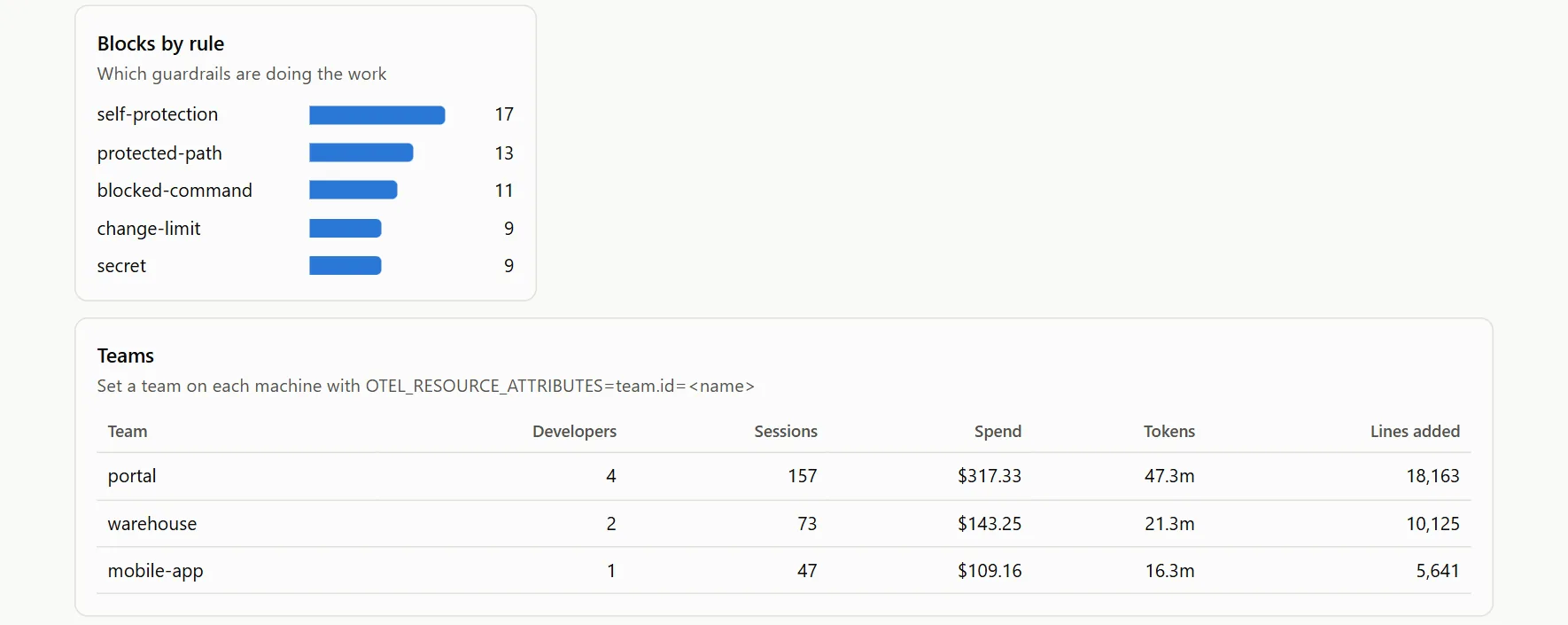
Claude Code sends its usage figures to the dashboard, tagged by team. It shows active developers, sessions, spend, tokens, how many edits were accepted, how many AI pull requests were merged, and which guardrails are doing the work. The dashboard runs on your own network.
Also in the toolkit
AI review on pull requests
Every pull request that isn't a draft gets inline review comments.
Tests on request
Add the ai-tests label to a pull request and tests are written for it.
An audit trail
Every block and every action the agent takes is logged, and the blocks feed the dashboard.
Organisation-wide policy
For companies that need it, the hooks can be enforced so developers can't switch them off.
In the demo
Where the demo ends up
Results from BridgeKit running on the demo repository, not from a client.
Bringing AI coding tools into your team?
Tell us about your team and your codebase. We'll explain what a rollout would involve, in plain English, usually within 1 business day.
Get in TouchNo obligation • No sales pitch • Plain English, always